DSotM@50

The most influential Pink Floyd album must be Dark Side of the Moon and it is 50 years old today
Dark Side of the Moon (1973)

One of the best-selling albums of all time and is in the top 25 of a list of best-selling albums in the United States. Although it held the number one spot in the US for only a week, the album remained in the Billboard 200 albums chart for 736 nonconsecutive weeks (15 years!) (from 17 March 1973 to 16 July 1988). The Dark Side of the Moon made its final appearance in the Billboard 200 albums during its initial run on the week ending 8 October 1988, in its 741st charted week. The album re-appeared on the Billboard charts with the introduction of the Top Pop Catalog Albums chart in the issue dated 25 May 1991, and was still a perennial feature ten years later.
https://en.wikipedia.org/wiki/The_Dark_Side_of_the_Moon#Sales
Eclipse
1972-76
One in five UK households owns a copy of Dark Side Of The Moon. It still sells 8,000 copies a week in the US alone. At any given second, the album is playing somewhere in the world. Its all-conquering “everyman” popularity seems all the more extraordinary given that it was made by a band that only a few years previously had been releasing ten-minute drum solos and cod-classical suites to an underground fanbase.
But Dark Side Of The Moon hardly appeared to the band in a flash of light. The record that caused such a huge shift in Pink Floyd’s fortunes was a long time coming — fifteen months from conception to completion. And it would also be a long time going —a commercial monolith that was the making of the band and, ultimately, nearly the breaking of them too. “The only reason we stayed together after [Dark Side] was fear and avarice,” said Waters later.

Both lyrically and musically Dark Side represents a return to earth after the Floyd’s — and everyone else’s — failed attempt to extend 60s utopianism via the early 1970s progressive” ideal. In its lyrics, madness (Barrett’s?) is seen simply as the end result not of a spiritual search but of material pressures —money, travel, human conflict (“Us & Them” ) – and more abstract but nevertheless mundane pressures such as time and mortality. The ongoing Vietnam War, the activities of the IRA and the backlash to sixties “permissiveness” represented by Mary Whitehouse’s reactionary Festival of Light were all contemporary symbols of the defeat of 1960s ideals. In the album’s music, progressive rock is drawn upon in the segued suites of songs, but they’re largely excised of their excesses, trimmed to three- or four- minute durations, and grounded in melodies and strong choruses.
Prog also provided a useful model in that Dark Side finally found a home for a whole series of fragments. But rather than being a rummaging through used laundry by a band who didn’t have enough new material for an album, Dark Side seemed to draw upon the past in order to summarize it, and — in the words of its original title — Eclipse it. The album would, in turn, prove very hard itself to eclipse.
Dark Side Of The Moon and side projects
After yet another American tour, in October and November 1971, the band reconvened at a rehearsal studio in Broadhurst Gardens, West Hampstead. With a major British tour booked from January 1972 onwards and concerts already booked throughout most of the next year, time was tight.

So, to start with, they sifted through old tapes. Wright came up with the unused piano chords from “The Violent Sequence” recorded for Zabriskie Point (and given a few live airings as an instrumental in 1970) and another he’d been pootling about with for a year or so, which became known as “Religion“. Gilmour, by his own admission, brought in no new songs. But Waters was on a roll, bringing in a strange, loping 7/8 riff he’d written on acoustic guitar (an embryonic “Money“), a lyricless “Time” and the prototype of “Brain Damage“, which he’d been playing at the Meddle sessions at which he called it “The Dark Side Of The Moon“. Perhaps it was this Barrett-inspired song that gave Waters the Big Idea for the album.
Gilmour has called this “the moment” —when Roger Waters came into Broadhurst Gardens with the idea of “putting it all together as one piece, with this linked theme he’d devised”. It is, however, a moment that, in typical Floyd fashion, is contested: Mason insists it occurred in his Camden kitchen. The concept has also been variously described. Waters initially flippantly called it “life with a heartbeat an’ that”, pointing out that “then you can have other bits: like all the pressures which are a anti-life” Wright said “It was about business.” Gilmour described “the specific idea of dealing it as with all the that drive people mad”. things Enthused by the band drew up a list idea of themes: encroaching old age, death, fear of flying, money and violence.
It was agreed that Waters would write all the lyrics, which he did quickly, coming up with words to “Time“, “Breathe” and “Us And Them” within a month. Much has been made of Waters’ new lyrical directness but he had used such an approach before (“Biding My Time , If , Free Four”), and although he curtailed his more whimsical poetic flights here, the words are still far from the confessional directness of the album he often cited as inspiration, John Lennon’s Plastic Ono Band.
And although it later irritated Waters, Dark Side was misinterpreted as containing cosmic meanings, the fact is that there’s still a certain elliptical, mysterious element to the words alongside the literalism.
Though the others weren’t to know it at the time, this decision to let Waters write the lyrics was one that would have enormous ramifications for the Floyd. For a start, the lyrics were key to the universal success of Dark Side Of The Moon, this new directness and simplicity striking a chord with the post-1960s generation “He wanted… to get away from all the psychedelic warbling’s and say exactly what he wanted for the first time,” said Gilmour. But in doing this they were also delivering Pink Floyd over to Waters’ personal world view — a general faith in humanity often undercut by a deep and acerbic cynicism. Perhaps smarting from later accusations of misanthropy, in the nineties and beyond, Waters repeatedly emphasized the project’s humanism: “Despite the rather depressing ending … there is an allowance that all things are possible, that the potential’s in our hands. “Nevertheless, in the knife-edge sarcasm of “Money“, the bitter ironies of “Us And Them“, the caustic hints of “Breathe Reprise” and that downbeat ending, lay the distinct seeds of something more acerbic.
What’s more, Pink Floyd were implicitly giving Waters a position of leadership. Gilmour has since regretted this, while remaining philosophical about his own abilities — and work ethic. “Roger worked all sorts of hours on the concept and the lyrics while the rest of us went home to enjoy our suppers.”
That said, the musical contributions of the others were absolutely vital to Dark Side’s success, with Wright, particularly, at his creative peak (though, once the royalties started pouring in, all four bickered about precisely who had done what).
Road-testing the Moon
The first attempted performance of what was then still known as Eclipse was at Brighton Dome on 20 January 1972, with the Floyd’s first integrated light show since 1968. Waters had made a tape loop for “Money” of coins chinking and paper tearing using his wife’s potter’s wheel, but the tape snagged, stopping the performance. So the first complete performance took place the next day at the Portsmouth Guildhall. Pink Floyd continued to play the piece for the next few weeks, culminating in four shows at the Rainbow on 17—20 February the piece by now titled Dark Side Of The Moon, A Piece For Assorted Lunatics. A “mind and sense-stunning experience” enthused the NME. “A magnificent production.” The Sunday Times described them as “dramatists supreme”. But the group weren’t entirely happy with the piece. Mason later recalled, “I didn’t really have any sense at first that Eclipse was anything particularly special . there was quite a lot of padding.”

At this point “Time” was much slower, lacking its later VCS3 drone and was sung in harmony by Wright and Gilmour on the verse. “Great Gig” was called “Religion”, and was played on organ not piano. It also featured taped readings from the Biblical Book of Ephesians and a recital by the broadcaster and journalist Malcolm Muggeridge, best known as a presenter of religious programmes and supporter of Mary Whitehouse in the censorious Festival of Light campaign. (In “Pigs (Three Different Ones)” , Waters would later make his feelings about Mrs Whitehouse very clear.) Closer to the eventual “Any Colour You Like” was “Scat”, another instrumental jam, featuring Gilmour scat-singing along to his guitar solo.
During the tour Waters wrote “Eclipse“, to pull the whole piece together. It was first added at the Leicester De Montford Hall show of 10 February, making this, technically, the full premiere of Dark Side Of The Moon. A less useful by-product of this road-testing was that their Rainbow performance was issued as a bootleg and racked up substantial sales before the Floyd were aware of it — some say 100,000 copies —a full year before the album’s official release.
Recording Dark Side
Just before Obscured By Clouds was released, recording proper for Dark Side Of The Moon began on 1st June, though it was now once more titled Eclipse. Often erroneously thought to have been Abbey Road’s first 24-track recording, Dark Side was actually recorded on 16-track, sometimes using two machines to accommodate the sheer weight of overdubs.
“Us And Them” was the first track recorded, and Gilmour immediately made his presence felt, taking over the lead vocal and adding layers of Beatles-like guitar arpeggios. He also made “Money” his own with his assertive vocal, improvised guitar line, and his variance of wet (echoey) and dry sounds in the mix.

He was all over “Time” with another blinding improvised guitar solo and a far more assertive vocal. When it came to recording “Great Gig In The Sky“, which Wright had been developing since the live shows, Gilmour responded by echoing the pedal steel part of “Breathe“. The band would end up tinkering with these tracks over a full six months.
After this bout of recording, the Floyd took a full two months’ holiday, before decamping for their second, fifteen-date US tour of the year on September 8, taking the retitled Dark Side Of The Moon with them. They returned to the studio in October for a further nine days’ recording, getting down “Brain Damage” and “Any Colour You Like“, now stripped of Gilmour’s sync’d vocal.
It was then that Floyd made the key decision to add female backing vocals to the album, adding a soulful warmth to the recordings (though the women reported the atmosphere among the frosty Floyd was anything but warm). Gilmour again played a key role here, directing the vocalists’ “ad libs”. It was also now that Dick Parry’s sax was added to both “Money” and “Us And Them“. An old Cambridge friend of Gilmour’s, jazzer Parry’s contribution added what Mason later admitted was a “commercial sheen”. But after the band dropped recording dates to play a War On Want charity show at Wembley Park, they were far from finished and had to pack up for a two-month-long European tour on 10 October.
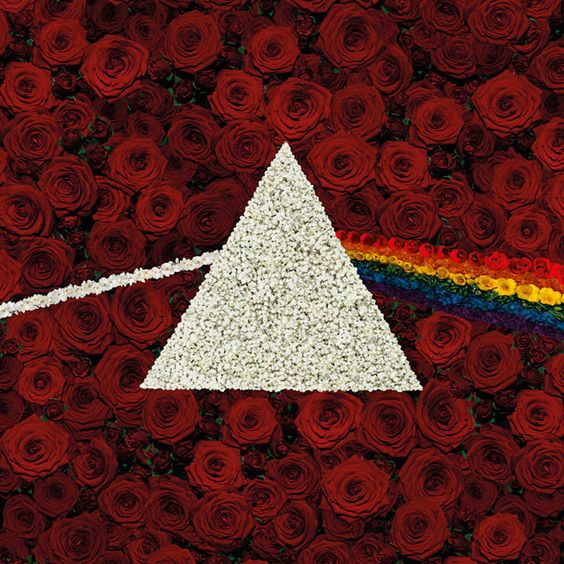
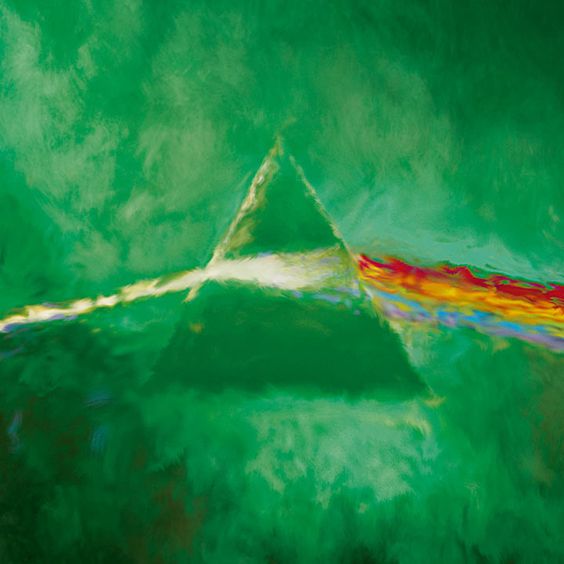
Re-Envisioned
The Cover of Dark Side Of The Moon
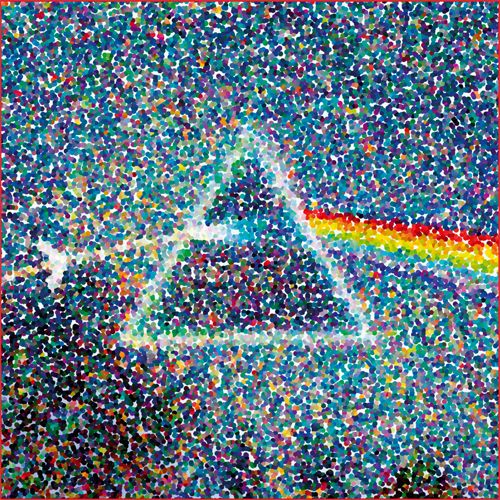
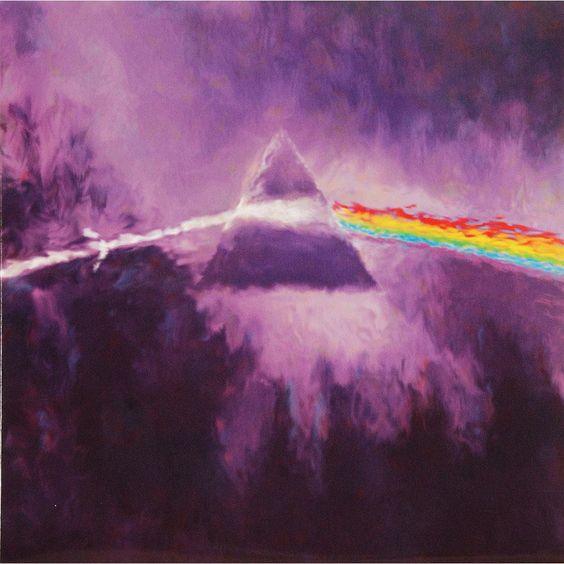
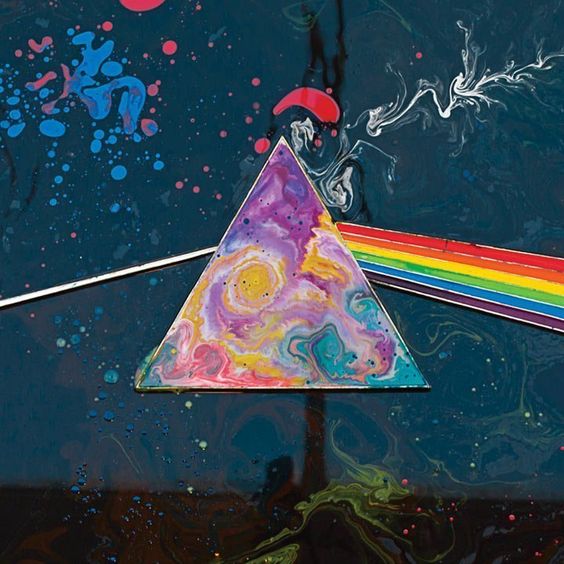
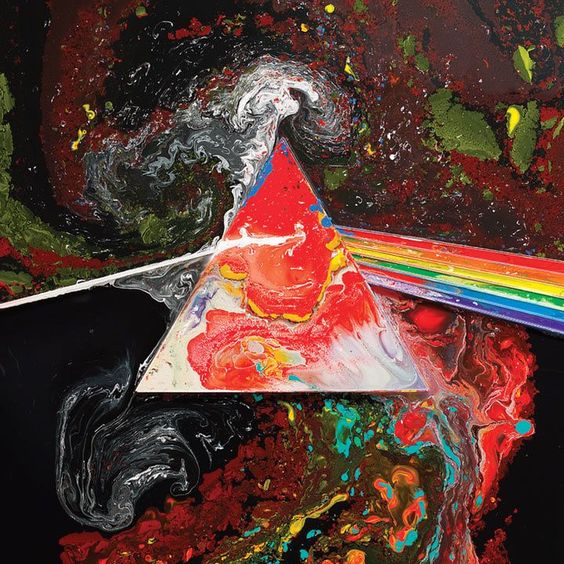
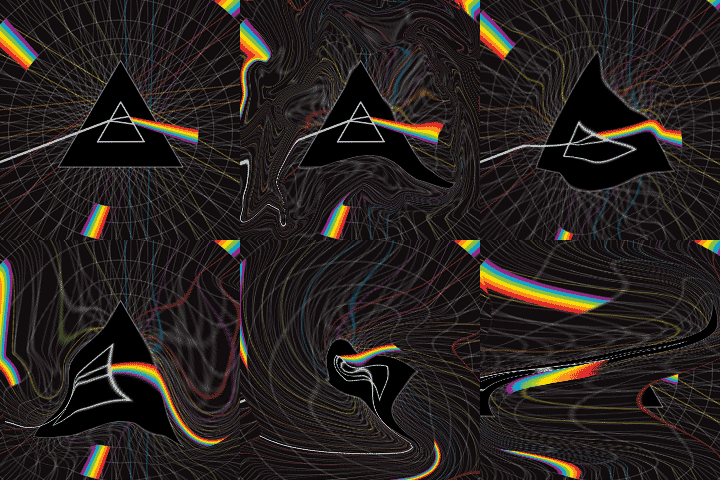
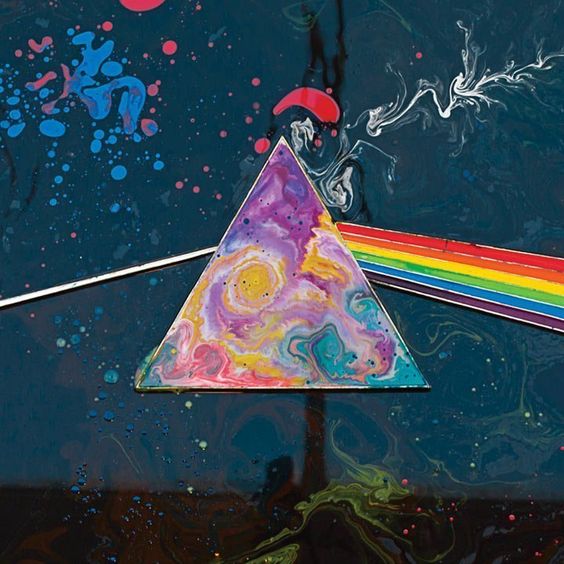
Inspired by Rick Wright’ request for something “simple, clinical and precise”, Hipgnosis prepared seven different designs. “[It] took about three seconds”, said Thorgerson, “in as much as the band cast their eyes over everything, looked at each other, said in unison, ‘That one’ and left the room. ” The prism that Pink Floyd chose, drawn by artist George Hardie, was a reference to the Floyd’s light show, while the triangle apparently symbolized “mad ambition”. The prism, incidentally, contained no indigo — a deliberate anti-realist touch. The spectrum becoming a monitored heartbeat on the inner gatefold was Waters’ idea, tying into the album’s opening sound effect. Thorgerson pursued the triangle theme further, travelling to Giza in Egypt to photograph the pyramid for the album’s poster. The cover (which has seen various changes for subsequent reissues) was crucial to the album’s success — a bold, simple image that’s instantly recognisable,





One in every fourteen people in the US under the age of 50 is estimated to own, or to have owned, a copy.
https://en.wikipedia.org/wiki/The_Dark_Side_of_the_Moon#Sales
The Dark Side Of The Moon
SPEAK TO ME/ BREATHE/ ON THE RUN/ TIME/ BREATHE(REPRISE)’/ THE GREAT GIG IN THE SKY/ MONEY/ US AND THEM ANY COLOUR YOU LIKE/ BRAIN DAMAGE/ ECLIPSE
Harvest; recorded June 1-3, 6-10, 13-17, 20-24 1972; October 10-12, 17, 25-27 1972; January 13-14, 18-21, 24-27, 29-31, 1973; February 1, 1973; released March 10 (US), March 23, 1973 (UK); available on CD
Looking back at The Dark Side Of The Moon, it seems as if nothing was left to chance, From its taut visual package in, Dark Side drew a clean graphic line under the experimental approach of Pink Floyd’s last four years and its embrace of happy —and not so happy —accident.
Instead the album was planned meticulously, making its mainstream success seem rather less random than its authors suggest. Dark Side was carefully worked out —from its central, cohering concept to the fact that actual songs were composed beforehand (rather than tracks being left to studio doodling lid the careful apportioning of responsibility in proportion no aptitude. Thus Waters took care of the lyrics (foregrounding a slightly sardonic simplicity) and Gilmour took the bulk of the lead vocals (providing warmth and prettiness) while, instrumentally, Wright and Gilmour were given free rein to create big splashes of harmonic and melodic colour throughout is direct, accessible approach was underscored by the use of female soul singers Dick Parry’s warm, breathy sax, the spoken passages to illustrate the concept, and the purchase of a crucial commercial sheen from outside mixer Chris Thomas.
As a consequence of all this care, even the hypes real-critical Floyd find it hard to fault the album, though Waters has called the lyrics “lower sixth”, and Gilmour sometimes mumbles about the drum sound. In fact, the only real dips in quality occur with “Money” (sound effects more interesting than song; instrumental section overlong) —and “Any Colour You Like“(filler), though even these sit happily amidst the linking dialogue and the album’s signature musical segues. And if Dark Side’s lofty musings on life, death and madness also sometimes appear a little pompous —English gramma school boys potting philosophy for homely, happy Americans — then a cursory Comparison The Who’s Tommy, Jethro Tull’s A Passion Play or Genesis’s Lamb Lies Down On Broadway soon puts such criticism into context. For unlike more abstract progressive conceits the album’s concept was, as Waters stated”, the first one that had a heart”. A heart that subtly affected the music of this previously most head-orientated of bands way beyond the literalness of the opening and closing heartbeat, saturating their always imaginative music with some depth and emotion.
As such Dark Side has outlasted almost all vagaries of fashion. Punk pilloried it, but the CD age rescued it; the hardcore late 1980s spat upon it, but the chemical generation spaced out to it; Britpop made it obsolete, but Radiohead made it more relevant than ever. And not for one second did it ever stop selling. Indeed, after 2003’s best ever (2.1) remastering, which alone shifted a million copies, Dark Side Of The Moon couldn’t now be in a more unassailable position if Pink Floyd had planned it that way.
The Tracks
Breathe (In The Air)
(Waters, Gilmour, Wright)
Recorded June 1972—Jan 1973; released on Dark Side Of The Moon
For all of Waters’ preliminary talk of “coming back down to earth” for Dark Side Of The Moon, “Breathe” is amongst the most ethereal, celestial and least grounded pieces in the entire Pink Floyd canon. And it’s all the better for it. Musically, this ethereality is achieved by Gilmour’s wafting, surging pedal steel, which manages to combine both the pastoral and the space rock approaches of the previous four years, and by the filigreeing of layers (Gilmour’s three vocal and three guitar tracks, Wright’s three keyboard tracks), building a magic castle out of humble two-chord rock. The Wright-penned chorus opens out to six harmonically expansive chords (partly inspired by Miles Davis’ jazz classic Kind Of Blue): Earth viewed from air, free from gravity’s pull. Waters’ symbiotically complementary lyrics may have gravity, but they are very far from being down-to-earth. Although closely related to his songs for the film The Body and their connections between man’s corporeality and his environment, the lyric of “Breathe” encompasses the pastoral (“run rabbit run”), whilst also being spacey and elusive. Living long and flying high suggests spiritual ease, but it’s conditional(“only if you ride the tide”) suggesting a simultaneous material stress. The lyrics are perhaps best not analysed too closely it’s evocative and enigmatic in the patented Pink Floyd style, with sufficient hints of Waters’ humanism (“don’t be afraid to care”) not to feel abstract. Waters could huff and puff all he liked about Pink Floyd being perceived as a space rock act (indeed the online music encyclopaedia All Music still calls them “the premier space rock band”), but when music is so far off into the ether as “Breathe”, classifications become as intangible as the song itself.
On The Run
(Gilmour, Waters)
Recorded January 1973; released on Dark Side Of The Moon
“On The Run” is a key departure from Pink Floyd’s signature laid-back style, a precursor of the more edgy and tense elements that would intrude during Waters’ later takeover of the band.
The hints of paranoia in “Julia Dream”, “Eugene” and “One Of These Days” are here given full musical rein; the tune’s clipped electronic minimalism all the more startling coming after the leisurely Floydian lushness of the preceding DSOTM track “Breathe”. Replacing the jammed “Travel” of early live versions, “On The Run” kept the concept (one close to any touring band’s mind, if not heart) but broadened it to its attendant stress and ultimately madness.
The music similarly expanded on what began as a rudimentary synthesizer doodle. Fiddling with the new VCS3 Synthi- A briefcase, Gilmour came up with a sequence of notes he then sped up to a blur; the ever-competitive Waters, listening, proceeded to play a different sequence.” I hate to say, it was marginally better,” Gilmour conceded. Despite its apparent minimalism”, On The Run” is actually a complex mesh of seventeen instrumental tracks, from a conventional set-up of electric guitar, bass, drums and piano amalgamated with electronics to suggest the frenzied motion of travel. But it’s the sound effects that give the tune its depth, a cinematic montage of hurrying footsteps, heavy breathing, mumbling roadies and Waters’ deranged cackling.
The use of the VCS3 synthesizer (see p.83) would have been innovative enough in itself, but it was truly pioneering in such a brutally minimalist form, prefiguring techno accurately. Waters was later dismissive of this genre, suggesting its creators did little more than plug the machines in. Given that this was an accusation levelled at the Floyd themselves, this sounds a little like defensiveness. But whether music be electronic or organic, technical accomplishment is less important than what is chosen and how it is presented, as this tune conclusively proves. It was perhaps Gilmour’s insufficient recognition of this fact in the 1980s and 1990s, however, that engaged Waters defensiveness, or, one might even say, his paranoia.
Time
(Mason, Waters, Wright, Gilmour)
Recorded June 8, 1972; released on Dark Side Of The Moon; also available on Echoes
One of the curious effects of Dark Side Of The Moon’s ubiquity is that such everyday sounds as a heartbeat or a ticking clock can now summon up Pink Floyd. While they couldn’t, of course, copyright these sounds (not least because it was engineer Alan Parsons who recorded the clocks), “Time” is still trademark Floyd — simultaneously cool yet emotional, confident but questioning. The song’s introduction alone is testament to this, its VCS3 drone, drum-machine like clicks from Waters’ Fender Precision bass and Mason’s ringing, tuned roto-toms being intensely dramatic, its clock-chime electric piano and sheer length being almost lackadaisically leisurely. Waters later said that “there was a serious lack of panic about losing the listener’s attention here”. Two minutes and twelve seconds’ lack, to be precise.
The song’s lyrics derived from Waters’ realisation, aged 29, that “there isn’t suddenly a line when the training stops and life starts.”
As such, Gilmour’s assertive bark adds a chiding urgency to the verse (“fritter” “waste”, run”, “death”), while Wright’s softer, more self-effacing tones utterly inhabit the introspection of the chorus, the filtered, disembodied backing vocals sounding simultaneously soulfully alive and creepily spectral.
Credited to the group, the demo aired on the Making Of Dark Side Of The Moon DVD suggests Waters wrote the basic song of “Time”, which the others finessed into something more epic. These inputs include Wright’s opening chord decorations (he was probably also responsible for tweaking the chorus chords from major to minor), Gilmour’s economical but effective guitar work and Mason’s dramatic roto-tom intro. Splicing said intro to the song’s end on the US B-side to “Us And Them” might have made “Time” more immediate for radio programmers, but it ruined the brilliantly bathetic climax: “thought I’d something more to say…” To make subverting pomposity itself sound pompous — now that was something the Floyd really could have copyrighted.
The Great Gig In The Sky
(Rick Wright)
Recorded June 25, 1972, October 1972 & January 21, 1973; released on Dark Side Of The Moon; also available on Echoes
After a series of rushed records, Pink Floyd had, since Meddle, acquired a reputation for taking an age to finish anything. A Freudian would equate this Floydian completion anxiety with fears about mortality, a subject foremost in the Floyd’s minds via a shared fear of flying and heightened as both Wright and Waters now approached 30. That death should be the subject of Dark Side’s longest gestating tune is thus entirely appropriate.
It didn’t start that way, however. Indeed, Wright has attested that, had death been in his mind, he wouldn’t have created such a beatifically beautiful chord sequence, The tune’s churchy sonority slotted perfectly into the incipient Dark Side, however, following the religious references of “Breathe Reprise”.
Known as “Religion” in early 1972 live performances, it featured only organ, taped religious readings and the voice of British conservative religious broadcaster Malcolm Muggeridge(a sure Waters touch). By the Floyd’s autumn American tour, the voices had been ditched, the sequence shifted to piano, the segue from “Breathe Reprise” rendered more seamless by redeploying its chords (transposed) in the introduction, and the tune had finally gained its theme, as “The Mortality Sequence”. But still the existential tinkering continued — the tune gaining Gilmour’s deliberate echo of his “Breathe” pedal steel part that October. Still discontent, they set to it again at the mixing stage. If Jerry Driscoll’s and Pete Watts’ spoken comments about death were key elements to what Waters now dubbed “The Great Gig In The Sky”, the vocals of session singer Clare Torry were conclusive. Torry’s jaw-dropping, almost orgasmic wails levitated “Gig” from atmospheric dirge to ecstatic eulogy, not so much quelling fear of death as making it actively appealing. In fact, so lambently soothing is the track that a re-recorded version was used to advertise Nurofen painkillers in the 1990s. The most seductive song about death until Radiohead’s (distinctly Floydian) “Pyramid Song” twenty years later, as PR for the Grim Reaper, “Great Gig” takes some beating.
Money
(Roger Waters)
Record June 7 /October 1972; released on Dark Side Of The Moon and US single; also available on A Collection Of Great Dance Songs (re-recorded) and Echoes
Although there’d been hints as far back as “Corporal Clegg”, and more recently in “Free Four”, “Money” represented the first full public flowering of George Roger Waters’ soon to-be-characteristic cynicism. As such, it must have given its author some satisfaction that “Money” followed in the sardonic footsteps of “Free Four” in opening up America for the Floyd. Given heavy rotation on FM radio, this song about wealth and greed was the key to Dark Side Of The Moon’s American success, climb into #13, and helping make the Floyd richer than even Waters’ sarcastically loaded lyric could hypothesize.
So far, so ironic. Or was it? It’s hard not to suspect that “Money” was a move as cynical as its sentiments. OK, it employs a slightly outré 7/8 tempo, but it remains in essence the kind of mid-70s blues-rock beloved of heartland American stoners, especially when it digs into a double-time boogie for the guitar solo (an idea Of Gilmour’s suggestive of a space-rock Allman Brothers). And any fool knew that sax meant hits in the 1970s. What’s more, Gilmour’s box-fresh American accent smacks of trying too hard, though he’s only acting up to Waters’ US-steeped lyrics (“a gas”, “bullshit” et al.).
Indeed, “Money” could pass for the work of an American an group were it not for Gilmour’s significant stumble on the word “class”. You can take the boy out of the Home Counties… As for that lyric — is it really so sarcastic? Waters says the band had “a shared goal, which was to become rich and famous”, often citing their “avarice” in continuing after Dark Side made riches and fame a reality. So perhaps those annoying audience members who took the lyric literally, as he and Gilmour complained, were just poetic justice for such a sustained — and dodgy — double-bluff was the track that made us guilty of what it propounds,” Gilmour later said. All of which would make this melodically monotonous song more interesting conceptually than musically, were it not for the combined efforts of another bravura production job, the song’s sound effects (so adroitly executed that they become the song’s hook) and the “violence” monologues, which distract from the song’s more self-indulgent instrumental noodling. On this track at least, Gilmour’s earnest muso-ness is rather less appealing than Waters’ cynicism.
Us And Them
(Waters, Wright)
Recorded June 1, October 1972; released on Dark Side Of The Moon; also on Echoes
Rarely has such harsh subject matter been presented in so mellow a manner as on “Us And Them”. This disparity derives from Rick Wright’s delicate piano chord sequence’s origin as the cleverly contrasting soundtrack to the police-student violence in Zabriskie Point, Though unused in the film, Pink Floyd played the piece live intermittently e; through the early 70s as “The Violent Sequence”.
Zabriskie’s loss was very much Dark Side’s gain: exhumed at Broadhurst Gardens in late 1971, the sequence —swapped to organ —inspired a similarly contrasting Roger Waters’ lyric. This concerned not just violence but the perceived differences — or contrasts —that cause it: between ordinary men on opposing sides in war (the most direct expression yet of Waters’ anger about his father’s death); between races (racist violence was on the increase in the early 1970s with the rise of the National Front); and between society’s haves and have-nots (a more complex, implicit violence in allowing the old man to die “for want of the price of tea and a slice”). A fiercely humanist lyric then, but one delivered with contrasting dispassion by Gilmour’s vocal.
Although Waters had sung lead on 1972 live versions’ verses, back in the studio the verses were given to Gilmour, his smoother, more clinical delivery more sharply contrasting with the lyric than the more subjective Waters, a detachment enhanced by the distancing delay effect (“Us, us, us…”). Tackling the chorus more sweetly than disharmonious live versions, Wright and Gilmour’s clipped Home Counties harmonies cool both the lyric’s anger and the levitational lift of the black backing singers.
The other musical additions stick to this script. Although the saxophone is usually a warm touch, Dick Parry’s gorgeous playing derives its inspiration from “cool jazz” legend Gerry Mulligan. Wright’s own piano solo is cut from similar hotel lobby cloth, pulling against roadie Roger the Hat’s amiably shocking “short sharp shock” violence monologue.
In all then, “Us And Them” is a quite brilliantly rendered study in contrasts —Pink Floyd at their creative peak.
Brain Damage
(Roger Waters)
Recorded June 1972—January 1973; released on Dark Side Of The Moon; also on Works
During the making of Dark Side Of The Moon, Rick Wright found himself unable to relate to the lyrics of “Brain Damage”, and considered the track to be the album’s “weakest link”. In fact this empathetic invocation of Syd Barrett’s condition is Dark Side’s emotional core and Waters could not but take Wright’s disinterest personally, particularly when Wright began broadcasting his overall lack of interest in lyrics in interviews. As such, the creation of this song can be seen to contain the seeds of the pair’s future “falingl-out”.
Doubtless the fact that “Brain Damage” is simplistic by muso, would-be-jazzer Wright’s standards, was crucial in its failure to engage his sympathy. The four-chord verse is rooted in Waters’ vein of folky fingerpickers, like “Grantchester Meadows” and “If” — notwithstanding the fact that, like “Breathe”, its pastoralism is refracted by the pattern being played on an electric by Gilmour. But the song’s music combines particularly potently with its lyrics, whose “lunatic on the grass” again refracts the riverside innocence of “Grantchester through the fear of madness of “If”. Waters had said both that the grass is a specific patch by the Cam he was told to keep off as a child, and that the lunatic is Barrett, whose “crazed insights” Waters more than equals here in the surreal imagery of newspapers holding their faces to the floor. Equally, by extension, the lunatic is all of us.
If, despite his own mental fragility, Wright felt himself exempted from this, he didn’t bunk off from the band’s all-hands approach to the four chord chorus, adding his Mini Moog and shimmer in Hammond to the pile of drums, guitar arpeggios, vocal harmonies and female backing singers. It was as if the band was grabbing the listener by the lapels to ensure an emotional response. But, pace Wright, it’s the way the music combines with Waters’ final spelling-it-out statement of empathy — “I’ll see you on the dark side of the moon” — that’s the key to Dark Side Of The Moon’s success, and consequently the difference between cult attraction and commercial breakthrough.
Eclipse
(Roger Waters)
Recorded June 1972—January1 973; released on Dark Side Of The Moon: also available on Works
It’s hard to imagine Dark Side Of The Moon could ever have existed without “Eclipse”, so perfect an ending is it. But “Eclipse” wasn’t added until Dark Side’s ninth performance, when Waters allegedly said to the others “here it is, boys, I’ve written the ending.” Bumptious as Waters was now becoming, he was so obviously correct that no one argued. Waters has described “Eclipse” as a “recitative of the ideas that preceded it”. While one can argue with his terminology (he means a lyrical recapitulation), one can’t argue with the track’s effectiveness. This lyrical summation of “Breathe”, “Time”, “Money”, and “Us And Them” forms a mantric cycle broken only by the closing couplet in which life’s positive David Gilmour kills some time with a spot of backgammon, 1973 aspects (symbolized by the sun) are eclipsed by the negative (the moon). This “depressing ending” (as Waters described it) doesn’t stop the song feeling euphoric however. Across a purposeful chorus-less, four chord pattern, the vocal and lyric have a sheer incantatory momentum, and the Floyd pull out all the musical stops. Literally so, in the case of Wright’s Hammond – it absolutely surges out of “Brain Damage”. Gilmour’s stately guitar arpeggios echo Abbey Road’s “Long Medley” and a further push is added every four lines: first the backing vocalists’ “oohs”; then Doris Troy letting rip; then Gilmour’s harmony; finally everyone joining forces at the journey’s end. “I’m only going to charge you L100 for my thing at the end,” Troy quipped to an apparently frosty Floyd upon her departure.
In fact they were very happy with the result. In what would prove to be a temporary mood of communal accord, “Eclipse” stands as godless gospel, a downbeat Pink anthem, and a negative celebration — Floyd in excelsis.
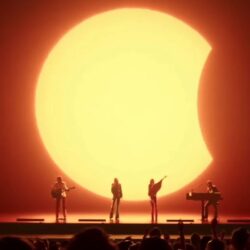
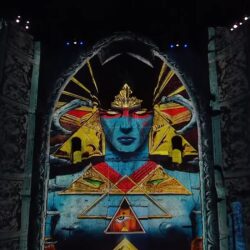
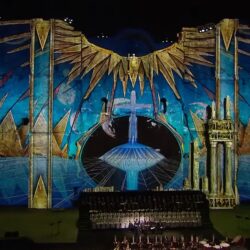
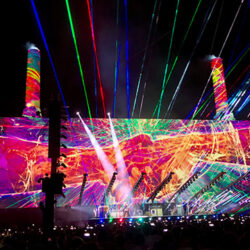
A Recent Tour coverage of DSotM: Roger Waters